
A love letter to time travel stories
And a special book offer
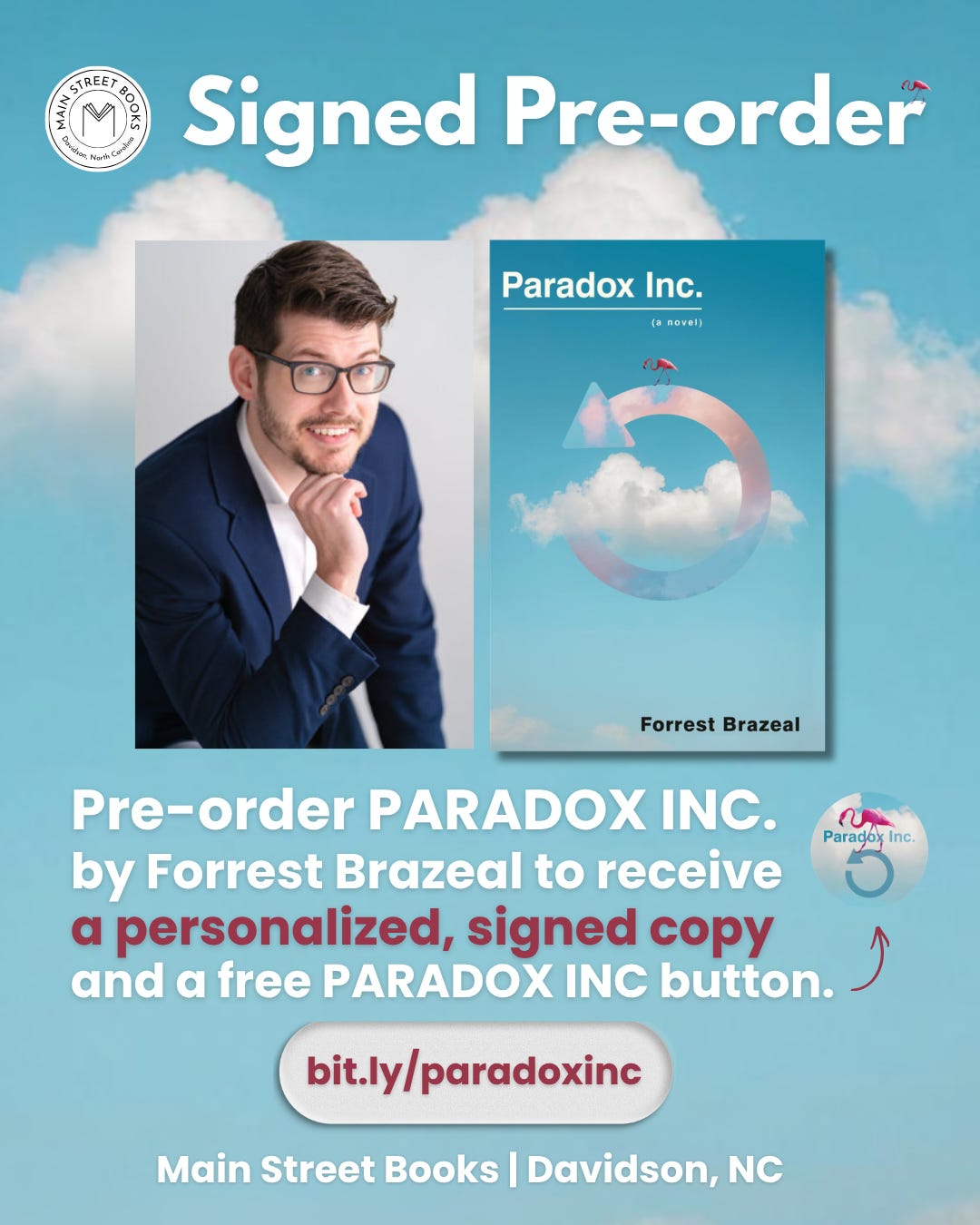
My hometown bookstore, Main Street Books in Davidson NC, is graciously hosting a pre-order campaign for PARADOX INC (out January 19th!).
If you purchase the book through them by January 18th, you will not only get a SIGNED copy of the book, but you can have it personalized to the recipient of your choice. AND you will get some kind of cool little flair pin that Penguin Random House made for you. All of this for the price of the book!
I mean, is that a great deal, or what?
A quick history of time travel
I wrote Paradox Inc. in part because I love a great time travel story — who doesn’t? And while I’ve tried to make it a fun, fresh story in its own right (the time travel mechanics may or may not be inspired by Git), I also tried to include respectful nods to different types of time travel stories people have enjoyed over the last hundred and fifty years.
It seems to me there have been, loosely speaking, four major eras in time-travel storytelling (we may now be entering a fifth, though that’s always hard to tell without a time machine of your own):
Era 1: Time travel as scientific adventure (1890 to 1930-ish)
HG Wells’ The Time Machine is the prototypical example of this genre, which is basically “cool science guy uses cool science to go forward or backward in time and explore cool things”. There’s usually a time machine1, there’s usually a scientist, and the focus of the story is on expanding the limits of human knowledge, with a pulpy, optimistic tone.
Remember, this was the heyday of National Geographic. Human exploration on earth had shifted from “let’s find nice places to live and/or exploit” to “let’s plant flags on the most treacherous, extreme places, for clout” — the poles, the deserts, eventually Mt. Everest and the moon. Time was the sci-fi version of the next frontier.
The standard storytelling format in this era was the pulp novel.
Era 2: Time travel as puzzle box (1930 to 1960-ish)
Heinlein’s By His Bootstraps and All You Zombies (the latter the basis for the Ethan Hawke movie Predestination) are the classic examples here. During this era, time travel stories became an unparalleled playground for weird, mind-bending twists: the butterfly paradox, the grandfather paradox, the bootstrap paradox. Exploration and grandeur took a back seat to cleverness and shock value.
There was a market reason for this: the midcentury era saw the last and greatest flowering of the magazine short story. Good writers got paid good money to come up with punchy, fun short fiction for prestigious, widely-read magazines. And time-travel twists were God’s greatest gift to short story writers. O. Henry could only dream.
So the defining format for innovation in this era (including the two Heinlein stories mentioned above, as well as stories by other great writers of the era like Jack Ritchie and Clifford D. Simak) was the magazine short story or novella.
Era 3: Time travel as head trip (1960s and 70s-ish)
I don’t see people discuss this as a distinct era very often, but it seems quite clear to me.
In tune with the counterculture, time-travel stories of the 60s and 70s turned inward: moving away from the hard sci-fi and intellectual rigor of earlier eras toward a softer, more subjective approach.
Instead of using time machines, the characters in these stories are more likely to travel through time via memories, dreams, drugs, or even (in the case of one infamous story from Harlan Ellison’s 1972 collection Again, Dangerous Visions) straight-up masturbation.
Jack Finney’s 1970 masterpiece, Time and Again, is the finest example of this era in my opinion, with Richard Matheson’s 1975 Bid Time Return (filmed as Somewhere in Time) a close second. Both books use self-hypnosis as the time-travel method of choice, and involve characters wandering the past in search of love (and, subtextually, in search of a nostalgic bygone era—another cultural timestamp of the disintegrating 70s).
The defining format of this era is probably the “book club” novel, like the two above—these softer time travel stories felt more literary and penetrated beyond traditional sci-fi readers.
Era 4: Time travel as video-game mechanic (1980s-ish to the 2010s)
I really can’t overstate the degree to which video game storytelling has taken over time travel narratives in the past 40 years. Time loops, spawn points, and strict lists of rules for interacting with the environment have all become de rigeur in both written and filmed media: Groundhog Day and its many knockoffs, Edge of Tomorrow, Stephen King’s 11/22/63, etc.
This era has made a lot of very fun movies.
Era 5 (maybe): Time travel as therapy (2010s and forward)
I’m not sure I’m ready to call this a standalone trend, but the latest wave of time travel books and shows do seem to have a high concentration of time travel tropes used as metaphors for people exploring personal identity and trauma.
These “eras” aren’t just historical trends: people continue to write in the style of each era as time goes on. Back to the Future, the GOAT of time travel movies, is clearly a 50s-era grandfather-paradox puzzle box story, which is why it was so smart to set most of it in the 50s. (Movies in general seem to lag book trends by a few years.) Michael Crichton’s Timeline is a straightforward pulp sci-fi adventure novel that happened to be written in the year 2000.
And many, if not most, time travel stories today use a mix of techniques. There are elements of all 5 eras in Paradox Inc—when you read the book, I hope you’ll let me know which is your favorite!
Once again, here’s that special pre-order link. Support an independent bookstore today!
Mark Twain’s A Connecticut Yankee in King Arthur’s Court, while technically a “time slip” story (instead of using a time machine, the science-loving protagonist travels by getting bopped on the head), very much fits into this category as well.
We are honored to host your pre-order campaign! This is such a great reading list to explore while we wait for January 19th.
Preordered! Love a good time travel story.